

Easterbrook-Clarke, L.H.; Hardie, S.; Hurst, A.W.; Petersen, T.; Scowen, P. 2025 Digitising Aotearoa New Zealand’s magnetic field data from 1951–1991. Lower Hutt, NZ.: Earth Sciences New Zealand. GNS Science report 2025/34. 43 p.; doi: 10.21420/71ET-XK33
Abstract
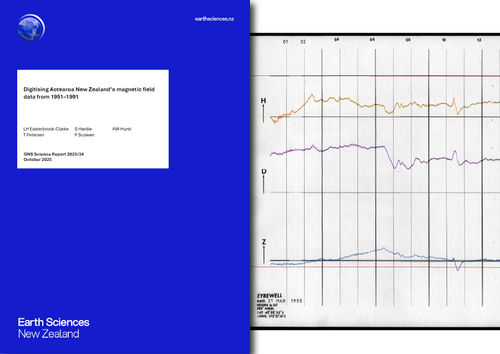
The Solar Tsunamis Endeavour Programme is an international collaboration led by the University of Otago, focused on understanding how Aotearoa New Zealand’s energy infrastructure could be affected by an extreme space weather event. This report is on the Digitising Magnetograms project within the overall programme. The Digitising Magnetograms project’s main objective was to digitise (capture time series data) Aotearoa New Zealand’s magnetograms (historical paper records of the magnetic field) from 1951 to 1990. The digitised storm data will be used along with digitally collected magnetic field data to improve storm forecasting (probability and intensity) using extreme value analysis. Magnetic observatories have operated in or near Christchurch since the early 1900s. An analogue magnetic variometer operates by shining a light source at a mirror with a magnet attached that is aligned with each of the components of the magnetic field. The mirror reflects the light onto a drum with photographic paper on it that goes through one full revolution each day. This piece of paper is a magnetogram which contains a full daily record of the magnetic field. Understanding how observatories in Aotearoa New Zealand operated and produced magnetograms has proved vital for the digitising efforts. Nearly 22,000 paper magnetograms were scanned or photographed into images by New Zealand Micrographic Services (NZMS) in 2021–2022. These cover the period 1916–1991, but this project only uses magnetograms from 1951–1991 where we have baseline and scale data used to derive absolute values. We used a variety of digitisation techniques to capture 2484 magnetograms representing ~14% of the magnetograms from this period. Additionally, we captured hourly data that had not previously been captured from annual reports. The various issues, challenges and methods of getting time series digital data in a usable format are presented in this report. These include issues with unlabelled or mislabelled magnetograms, lines crossing over each other, high fluctuations in data on stormy days etc. Notably the process to derive absolute values required discovering additional notebooks and worksheets. Techniques to derive baseline values using historical hourly data were developed. A robust quality control process was used to ensure the data was good quality (auths)
Note - Data associated with this report are available through the Dataset Catalogue: https://doi.org/10.21420/114e-1e30


